
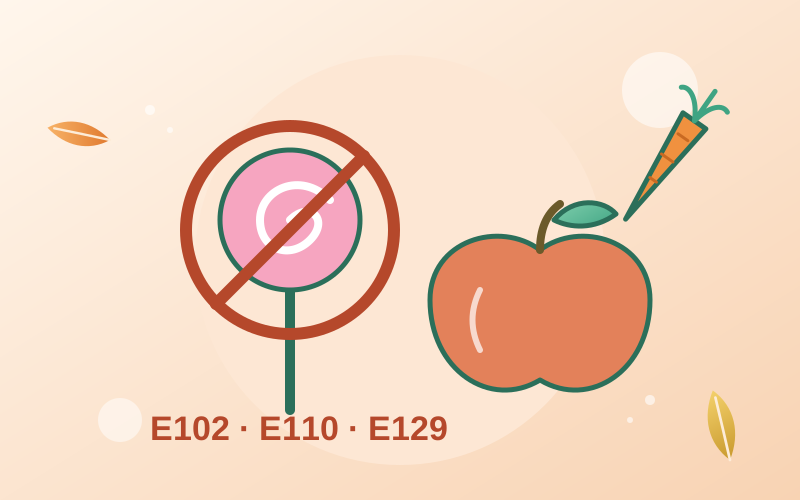
A birthday party at nursery, sweets “for good behaviour”, a brightly coloured drink from the school shop. And then – crying, shouting, irritability, trouble falling asleep. Many parents notice that after sweets and colourful snacks their child behaves completely differently. Is it just an impression?
In this guide I explain what happens in a child's body after a large portion of sugar, what research says about artificial food colourings, how to read labels and how to cut down on additives in your child's diet without a fight.
Important: if your child has difficulty concentrating, hyperactivity or temper outbursts, it is worth consulting a paediatrician. Diet can affect behaviour, but it is not the only possible cause – and ADHD is a neurodevelopmental disorder that diet neither “causes” nor cures on its own.
What happens in a child's body after sugar?
A rapid rise and a sharp fall
When a child eats a large portion of sweets or drinks a sugary drink “on an empty stomach”, blood glucose rises quickly. The pancreas responds by releasing insulin, which lowers blood sugar – sometimes more than necessary. After 1–3 hours there may be a drop in glucose (so-called reactive hypoglycaemia, or simply large swings in blood sugar).
A child's brain is particularly sensitive to such swings. The body responds to falling blood sugar with stress hormones – adrenaline and cortisol – which may show up as:
- irritability, tearfulness, “tantrums”,
- aggression and outbursts of anger,
- difficulty concentrating, restlessness,
- sudden hunger and demands for another sweet snack.
What does research say? Controlled studies do not confirm that sugar on its own causes hyperactivity in most children. However, large glucose swings, eating sweets instead of a meal, tiredness and excitement (e.g. at a party) can together worsen a child's mood and behaviour. Regardless of its effect on behaviour, too much sugar promotes tooth decay and excess weight and pushes nutritious food out of the diet – so it is worth limiting.
Naturopath's tip: if there are sweets – let them come after a meal, not instead of one. Protein, fat and fibre from lunch slow down the absorption of sugar and soften the “rollercoaster”.
The “Southampton Six” – colourings to watch out for
In 2007 researchers from the University of Southampton published a study in The Lancet in which children aged 3 and 8–9 drank drinks containing a mix of artificial colourings and a preservative (sodium benzoate). An increase in hyperactivity was observed in some children – including children without an ADHD diagnosis.
As a result the European Union introduced a requirement for products containing these colourings to carry the warning: “may have an adverse effect on activity and attention in children”. It concerns six colourings:
| Code | Name | Colour |
|---|---|---|
| E102 | tartrazine | yellow |
| E104 | quinoline yellow | yellow |
| E110 | sunset yellow FCF | orange |
| E122 | azorubine (carmoisine) | red |
| E124 | ponceau 4R (cochineal red A) | red |
| E129 | allura red AC | red |
You will most often find them in jelly sweets and candies, brightly coloured soft drinks, ice cream, sprinkles and icing on cakes, some crisps, chewing gum and powdered desserts.
Naturopath's tip: look for the sentence about effects on “activity and attention in children” on the label – it is the quickest way to spot a product containing the “Southampton Six”.
Monosodium glutamate (E621) and flavour enhancers
Monosodium glutamate (E621) is a flavour enhancer found in crisps, instant soups, stock cubes, ready-made sauces and fast food. Research does not confirm that it is neurotoxic in the amounts eaten in food, and the European Food Safety Authority (EFSA) has set a safe intake level. Some people do, however, report headaches or feeling unwell after it.
What matters more is something else: flavour enhancers occur mainly in ultra-processed food, which is very salty, fatty and “addictively” tasty. Such products teach a child that natural food is “tasteless” and push vegetables, grains and home-cooked meals out of the diet. By limiting E621, you are limiting a whole group of foods that do your child no good.
Effects at school and at home
Parents and teachers often notice that a diet full of sweets and colourful snacks goes hand in hand with:
- difficulty concentrating in class, especially before noon,
- mood swings and conflicts with peers,
- trouble falling asleep and restless sleep (especially after sweets and caffeinated drinks in the evening),
- temper outbursts at home – often during the “energy dip” after school,
- more frequent infections and less appetite for “normal” meals.
Diet is not always the cause – but it is worth checking first, because it is a factor parents can really influence.
Practical solutions for parents
How to read labels – 5 steps
- Read the ingredients from the beginning – they are listed starting with the one present in the greatest amount.
- Look for hidden sugar: glucose-fructose syrup, glucose, fructose, dextrose, maltodextrin, agave syrup, concentrated fruit juice, molasses.
- Check “sugars” in the nutrition table – 4 g of sugar is about 1 teaspoon.
- Watch for the colourings E102, E104, E110, E122, E124, E129 and the warning about children's attention.
- A shorter ingredient list = usually a better choice. If you do not know what half the ingredients are, put the product back.
Healthy swaps
| Instead of… | Try… |
|---|---|
| colourful jelly sweets | unsulphured dried fruit, homemade jellies made with juice and agar |
| sugary drinks, fizzy pop | water with a slice of orange and mint, homemade compote |
| fruit yoghurt with sugar | natural yoghurt with fruit and a teaspoon of honey (for children over 1 year) |
| chocolate bar | energy balls made of dates, oats and nuts |
| crisps | homemade kale or sweet potato crisps, air-popped popcorn |
| chocolate cereal | porridge with apple and cinnamon |
How to talk to your child
- Don't scare them (“sugar is poison”) – explain simply: “this food gives you energy for a moment, and then you feel tired and grumpy”.
- Don't reward with sweets – reward with time, playing together, an outing.
- Involve your child in shopping, reading labels and cooking – children are more willing to eat what they have prepared themselves.
- Set an example – children eat what adults eat.
- Leave room for exceptions – a friend's birthday party is not a failure. What counts is everyday life.
The challenge: 14 days without sweets and artificial colourings
Suggest a two-week experiment to the whole family:
- Preparation (day 0): go through the cupboards together, put away sweets and products with colourings, make a list of swaps.
- Days 1–3: it may be hard – your child may demand sweets. Make sure there are regular meals every 3–4 hours with protein and fat.
- Days 4–10: taste starts to change – fruit becomes sweeter. Try new recipes.
- Days 11–14: observe sleep, concentration, mood and appetite.
- After 14 days: write down what has changed. Many families decide to keep the new habits.
Naturopath's tip: keep a simple diary: what your child ate, how they slept, how they behaved. After two weeks you will see connections you had not noticed before – and gain arguments for talking with your child.
Summary
- Large portions of sugar instead of a meal can cause blood glucose swings and make a child feel worse.
- The six Southampton colourings (E102, E104, E110, E122, E124, E129) may increase hyperactivity in some children – in the EU they must carry a warning on the label.
- E621 is above all a sign of ultra-processed food.
- A parent's most effective tools are reading labels, swaps, conversation and setting an example.
Consultations for children and families – naturopath in Wrocław
Want to change your child's diet but don't know where to start? Is your child a fussy eater, often ill or struggling to concentrate? At Gabinet Zdrowia in Wrocław I help families put together a diet suited to the child's age and needs – with practical recipes and a plan of gradual changes.
Book a visit online or call: +48 501 748 753.
This article is for information and education only and does not replace medical advice. Please consult a doctor about any health problem.